microK 70 and microK 125
Taking the same platform into primary standards work, which meant an order of magnitude and a great deal of trouble.
The original microK gave us a platform good enough for secondary calibration. The question that followed, more or less immediately, was whether we could take it into the primary standards market, where it would have to match the AC bridges outright.
That meant 0.1 ppm, and it meant improving two things at once. The converter’s linearity had to improve, which came down to reducing timing jitter to below a picosecond. For scale, that is the time an electrical signal takes to travel about a third of a millimetre. Separately, the input noise had to come down far enough that the improved linearity was worth having, and no existing approach got us there, so we developed a parallel analogue processing technique that is still ours alone.
We also had to improve our own calibration capability before we could tell whether any of it had worked. Discriminating linearity errors on a 0.1 ppm instrument needs a laboratory capable of 0.01 ppm, and building that was a project in itself.
Paul wrote at the time that we had gone in with “optimism, born of ignorance, that sowed the seeds of later frustrations”. The article is worth reading for the honest account of how that went.
The parallel analogue processing that came out of it outlived the instrument. The microK² ELITE and microK² 60 were designed from it.
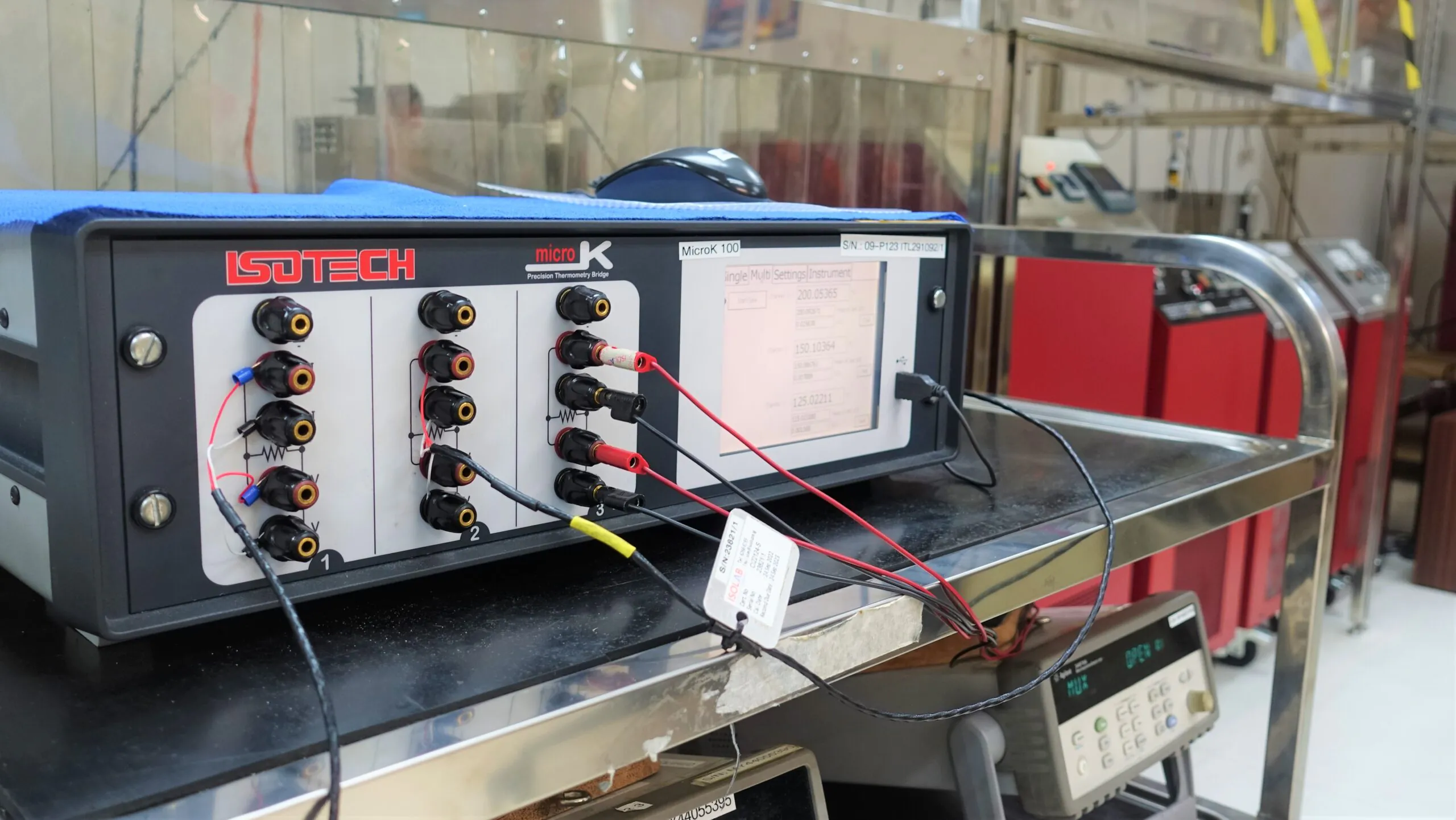
Metrosol carried out the research, design and development of the microK 70 and microK 125, working with Isotech from the initial stages. Isotech brings the instruments to market, supplying, calibrating and supporting them worldwide.
Isotech temperature calibration