The problem that has held noise thermometry back.
Johnson noise is a random signal measured in microvolts. So is interference. Every previous attempt at a practical noise thermometer ran aground on that, which is why the immunity result matters more than it sounds.
A noise thermometer is, by construction, an extremely sensitive wideband radio receiver pointed at a resistor. Any external field that reaches the sensor or its leads arrives as additional apparent noise, and additional apparent noise reads as additional apparent temperature.
Filtering it out afterwards does not work. The interfering signal has unknown characteristics and can be statistically indistinguishable from the thing being measured, so any attempt to subtract it is a guess dressed as a correction. Earlier efforts in this field tried, and it is a large part of why noise thermometry stayed in national laboratories instead of reaching a plant.
We took the other position, which was to keep the interference out of the measurement in the first place. The design detail behind that is not published here, but the test results are.
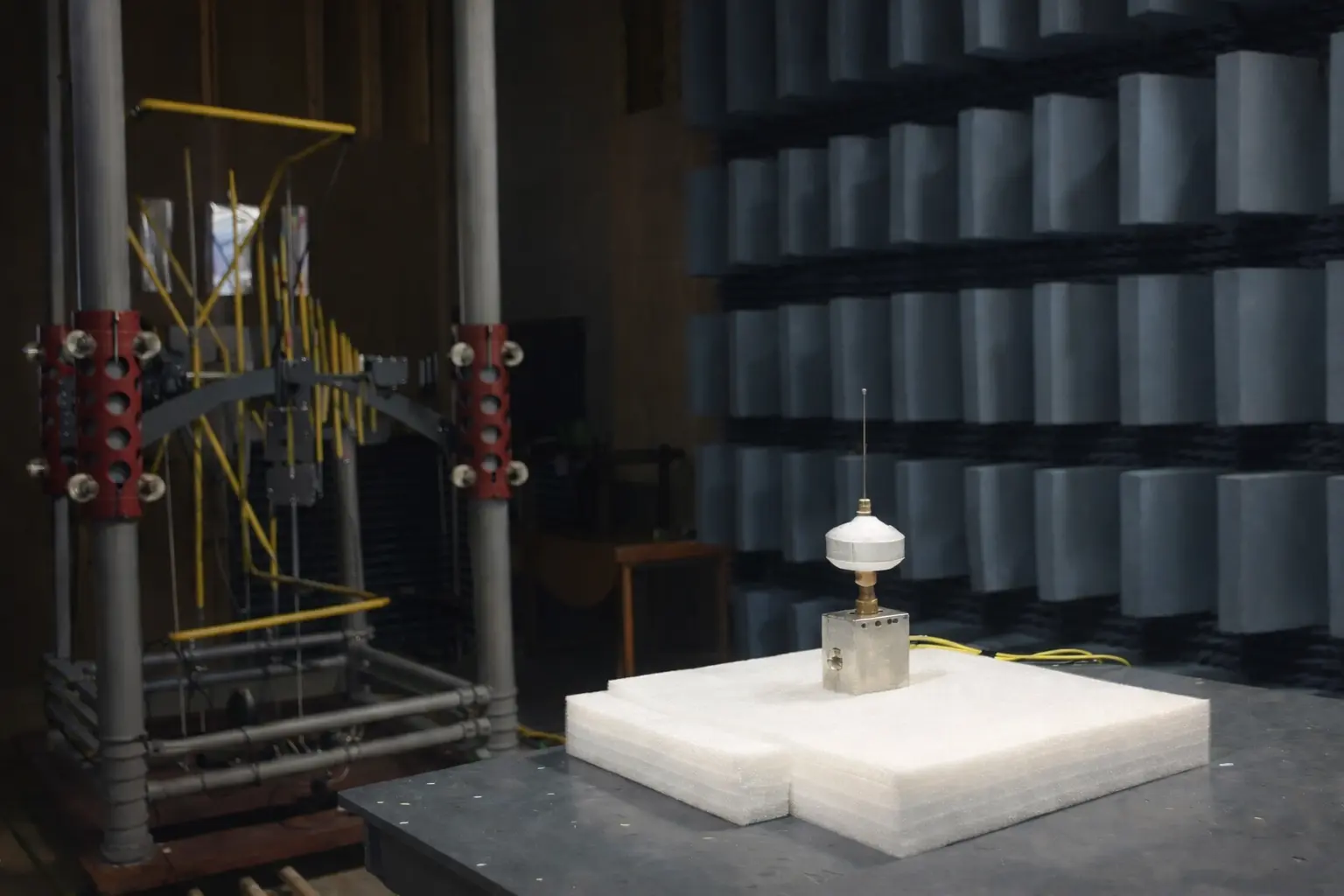
The test, and what it returned
| Standard | EN 61000-4-3 | radiated radio-frequency electromagnetic field immunity |
|---|---|---|
| Field strength | 10 V/m | 80 MHz – 1 000 MHz |
| Field strength | 3 V/m | 1.0 GHz – 2.7 GHz |
| Severity | Heavy industrial | the most extreme level defined in the standard |
| Result | No observable effect | the thermometer went on reading correctly throughout |
| Laboratory | Third-party, accredited | 10 V/m was the highest field it could generate |
| Category | Passed | the more demanding of the two industrial immunity categories |
Tested to EN 61000-4-3 at a third-party accredited laboratory. Reported in Developments Towards an Industrial Johnson Noise Thermometer, §6.
What heavy industrial means
EN 61000-4-3 defines immunity levels by the environment the equipment is expected to survive. The heavy-industrial level is the top of that scale: the electromagnetic environment of a plant with large switched loads, high-power drives and hand-held transmitters in use nearby. Ten volts per metre is a field strength you would encounter standing close to a working radio transmitter.
Our thermometer was unaffected, and passed in the more demanding of the two industrial immunity categories the standard defines. So far as the published record shows that makes it the first Johnson noise thermometer able to work in real industrial electromagnetic environments to a recognised standard, and not only in a screened room.
Beyond the standard
Compliance testing covers 80 MHz upwards. The measurement itself lives between 10 kHz and 1.2 MHz, well below that, and interference landing directly in the working band would be the more dangerous case even though no standard requires testing for it.
Early versions did occasionally show something we could attribute to AM broadcast transmissions. The current design does not: the measured spectrum stays smooth, and we check it routinely during experiments and across a range of sites in the UK and abroad. The most aggressive informal test we have run put the probe against the case of a cathode-ray monitor, next to the deflection circuitry, which is roughly the worst nearby field an ordinary building can offer. Only in direct contact did anything appear at all.
The standard, the levels and the result are reported in Developments Towards an Industrial Johnson Noise Thermometer (2019), §6.
We publish the immunity levels and the category passed. The laboratory’s report itself is commercial-in-confidence, and the design work behind the result stays with us.