Current development status.
This page records what the programme has achieved so far, with links to the papers and project records behind each milestone. It is updated as the work progresses.
From bench system to handheld prototype
The proof-of-principle system weighed 35 kg and occupied 70 litres, much of it made up of commercial instruments performing functions now handled by our own purpose-built electronics. The current aim is to bring the complete instrument below 1 kg and 1 litre.
Everything the rack on the left was doing now happens inside the unit on the right, and the probe goes straight into the front.
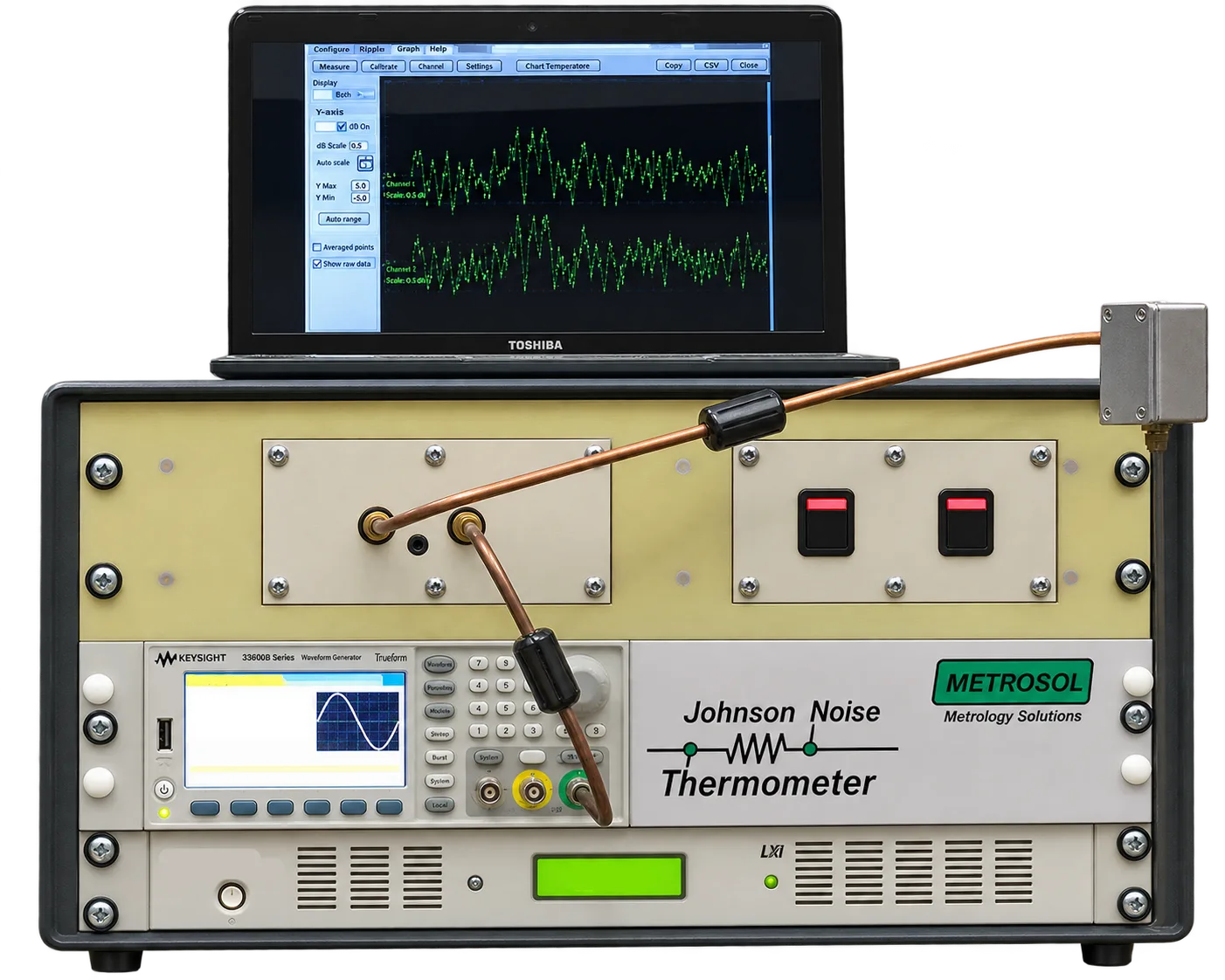
proof of principle · 35 kg · 70 L
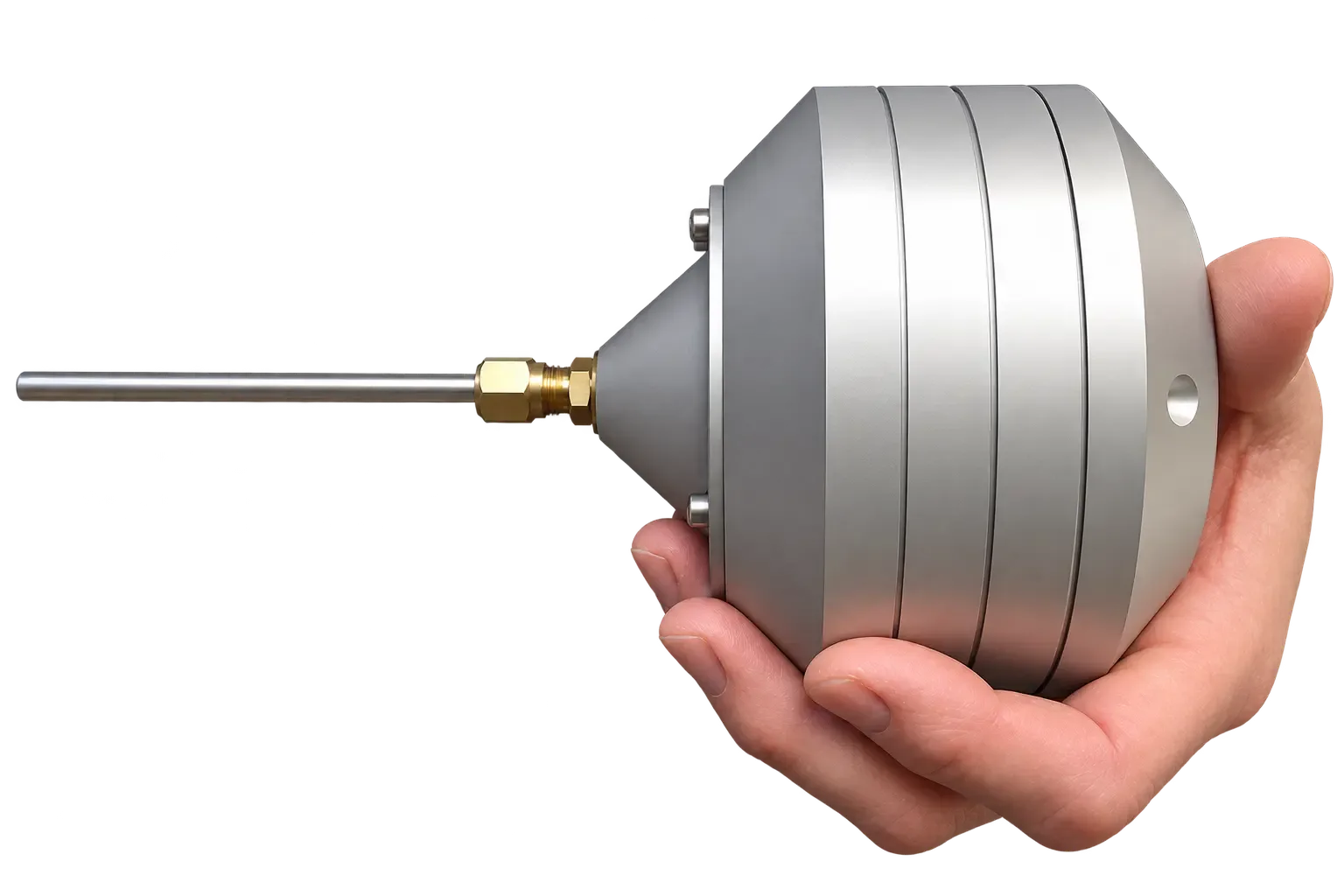
current unit · target <1 kg · <1 L
The mass and volume are from Developments Towards an Industrial Johnson Noise Thermometer (2019), §4.
The programme
Milestones reached, not milestones forecast. Each date comes from the published record or from our own project records.
- 2004
Metrosol is formed
Paul Bramley sets up the company in Paulerspury, Northamptonshire.
- 2014
Innovate UK backs the civil nuclear case
The initial phase is part-funded as a feasibility study under the Development of the Civil Nuclear Supply Chain competition.
- 2015
First joint paper with NPL on harsh environments
Pearce, Greenen, Bramley and Cruickshank present the case for a noise thermometer built for long-term measurement where sensors cannot be retrieved.
- 2016
Proof of principle: 35 kg and 70 litres
The first working system fills a rack and leans on commercial instruments for digitising and signal generation. It works, though it is not going anywhere in a hurry.
- 2017
The founding paper
The full account of a practical, drift-free noise thermometer for industrial use appears in the International Journal of Thermophysics, with NPL as co-author.
- 2017
Queen’s Award for Enterprise
Awarded in the Innovation category for the microK, developed with Isotech, and presented at Metrosol that September.
- 2019
Second-generation prototype: bespoke electronics throughout
A 24-bit A-D converter of our own design replaces the commercial instrument, cutting the converter alone from 6,970 cm³ to 16 cm³ and from 45 W to 3.3 W.
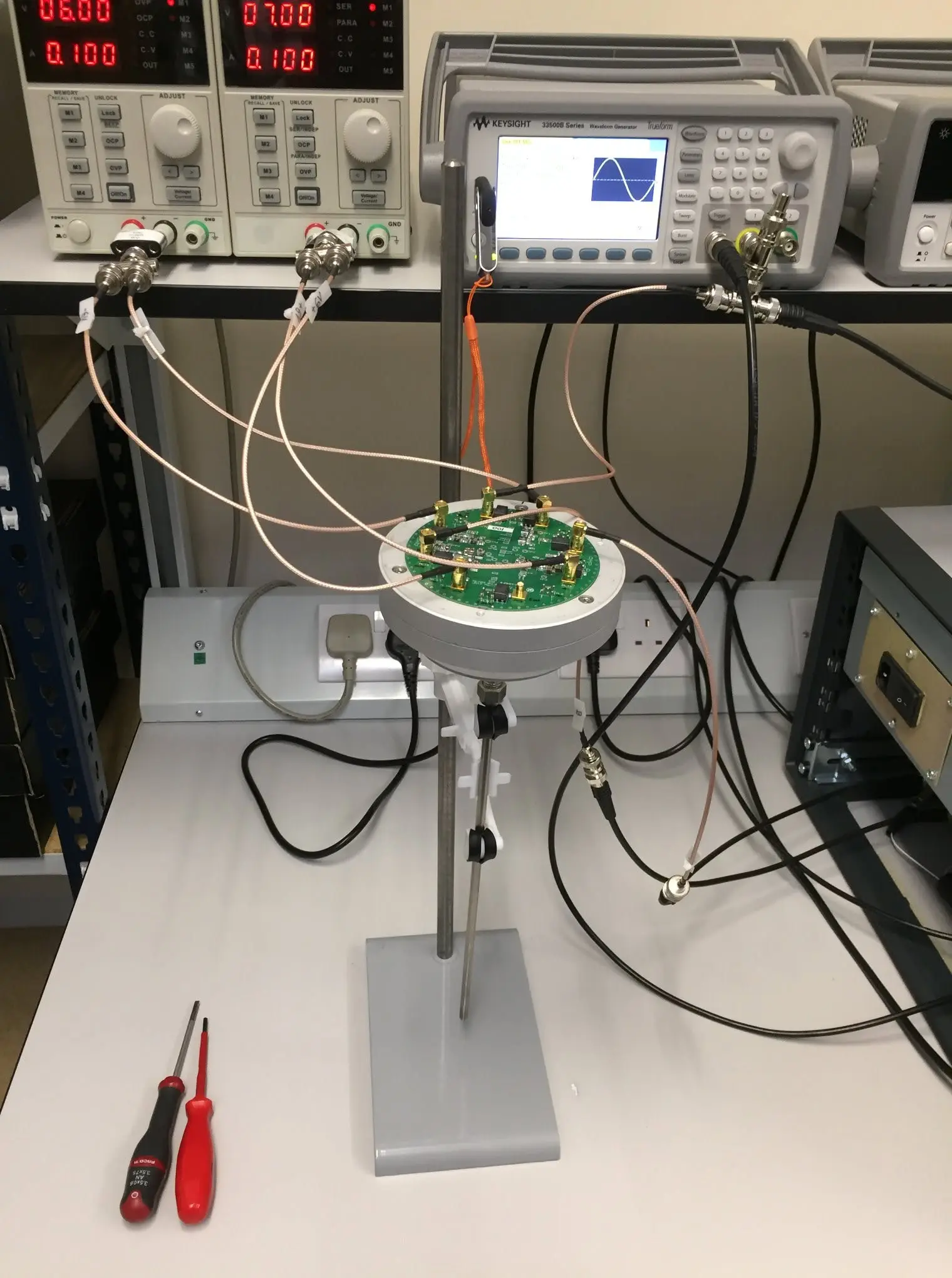
Bench testing the second-generation electronics. - 2019
The underlying physics holds
Noise power measured across a range of bath temperatures projects back to −273.415 °C at zero power, against a true absolute zero of −273.15 °C.
- 2019
Heavy-industrial EMC immunity, at an accredited laboratory
Electromagnetic interference had defeated every previous attempt at a practical noise thermometer. Ours is undisturbed at the highest level the laboratory could generate.
- 2019
Paul Bramley receives the Callendar Medal
Presented at the Royal Institution by the Institute of Measurement and Control, for the development of a practical Johnson noise thermometer. A personal award, and Paul was quick to name everyone else on the project.
- 2020
Journal publication, and the nuclear case in EPJ
The developments paper appears in Measurement Science and Technology; Pearce, Bramley and Cruickshank set out the nuclear application in EPJ Web of Conferences.
- 2023
Shown to the nuclear sector at Harwell
NPL, Metrosol and the University of Manchester present the thermometer for harsh environments up to 600 °C at the Remote Monitoring of Sensitive Sites demonstration day, on 14 June.
- 2024
NPL puts the converter on a Josephson standard
Under the Measurement for Quantum scheme, NPL calibrates the thermal voltage converter and measures converter linearity against a programmable Josephson voltage standard. The test finds a nonlinearity at negative voltages, and the fault behind it is resolved.
- 2024
Challenges and solutions published in the ITS10 proceedings
The current account of the programme, in the AIP proceedings of the symposium that sets the agenda for this field.
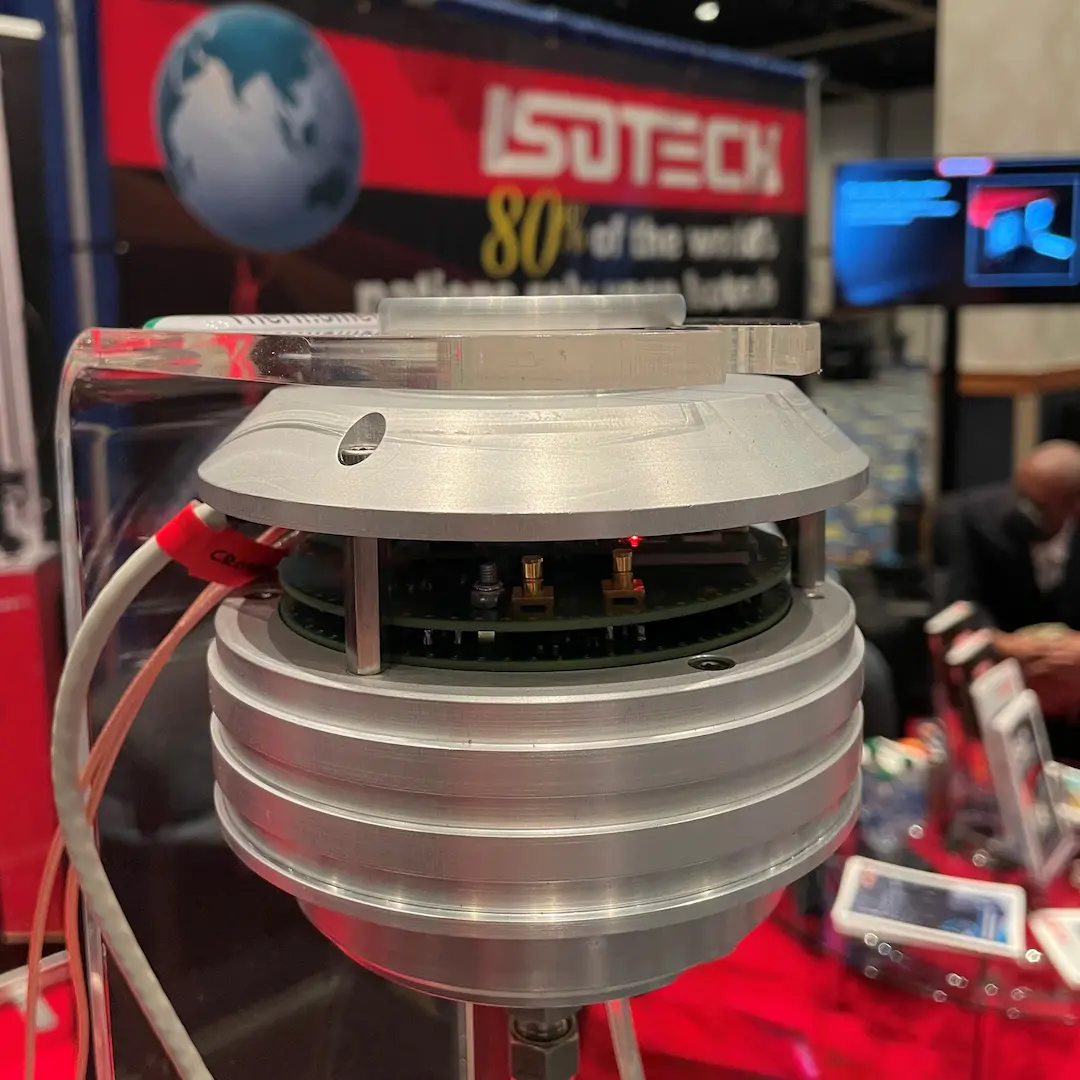
At the Tenth International Temperature Symposium. - 2024
ThermoSI takes the work towards 1,200 °C
European work package 2 sets a target uncertainty below 3 °C at 1,200 °C, alongside sensor elements that survive high temperature and ionising radiation.
- 2026
Isotech acquires Metrosol
On 2 April 2026, twenty years of design partnership was brought in-house. We keep our own staff and carry on with the research; the thermometry programme continues inside the group.
Measured results
Everything here comes from work we have published.
- Measurement performance of 0.1 per cent in 5.3 seconds
- 0.1 % in 5.3 s
- Extrapolating measured noise power to zero gives a temperature-axis intercept of −273.415 °C, against a true absolute zero of −273.15 °C
- −273.415 °C
- The intercept is more than five times closer to absolute zero than the proof-of-principle prototype managed under similar measurement parameters
- −271.79 °C → −273.415 °C
- Weighting the cross-correlation frequency bins by the inverse of their squared uncertainty reduced measurement uncertainty by 28 per cent
- 28 %
- The proof-of-principle prototype weighed 35 kg and occupied 70 litres
- 35 kg · 70 L
- The bespoke 24-bit converter replaced a commercial 16-bit instrument, cutting power from 45 W to 3.3 W and volume from 6,970 cm³ to 16 cm³
- 45 W → 3.3 W · 6,970 cm³ → 16 cm³
- Tested for radiated RF immunity to EN 61000-4-3 at 10 V/m from 80 to 1000 MHz and 3 V/m from 1.0 to 2.7 GHz
- 10 V/m, 80–1000 MHz · 3 V/m, 1.0–2.7 GHz
- The thermometer was unaffected by the applied fields, making it the first Johnson noise thermometer able to work in extreme electromagnetic environments to official standards
- The sense resistance is typically 5 kΩ, where prior-art Johnson noise thermometers use around 100 Ω
- 5 kΩ
- The measurement uses a bandwidth of 1.2 MHz
- 1.2 MHz
- The thermometer works over the band 10 kHz to 1.2 MHz
- 10 kHz – 1.2 MHz
- Standard deviation of 1.08 °C at 1,000 °C for the first high-temperature Johnson noise thermometer system
- 1.08 °C at 1,000 °C
- At 1,000 °C a thermocouple shows less short-term scatter than the noise thermometer, at 0.47 °C against 1.08 °C
- 0.47 °C thermocouple · 1.08 °C JNT
- Sensor resistance and Johnson noise are measured from the same block of data, so the resistance is measured rather than assumed
- 6.5536 s
- Converter linearity measured by NPL against a Josephson voltage standard
- Josephson-traceable
Programme targets, not results
These two are where the work is going. They are published as targets and are listed separately so they cannot be read as things already achieved.
- The programme target is to bring the whole system under 1 kg and under 1 litre
- <1 kg · <1 L
- ThermoSI work package 2 is taking practical Johnson noise thermometry to 1,200 °C, with a target uncertainty below 3 °C
- <3 °C at 1,200 °C
Measurements from Developments Towards an Industrial Johnson Noise Thermometer (2019) and Challenges and solutions in the development of a Johnson noise thermometer (2024). All of our papers are on the publications page.
Where the programme has reached
The Johnson noise thermometer is a working second-generation prototype, not yet a catalogue instrument. Electronics of our own have replaced the commercial instruments the first system leaned on, taking the converter alone from 6,970 cm³ to 16 cm³, and it passed heavy-industrial EMC immunity testing at the highest level the accredited laboratory could apply.
We are working with application partners to prove the technology in specific environments. If you are responsible for a temperature measurement that conventional thermometry does not solve well, we would like to hear about it. Those conversations shape what the first production instrument does.
New milestones are also posted on LinkedIn.