Awards and recognition.
Recognition for Metrosol and for Paul Bramley, together with a continuing role in the European consortium.
Queen’s Award for Enterprise, Innovation
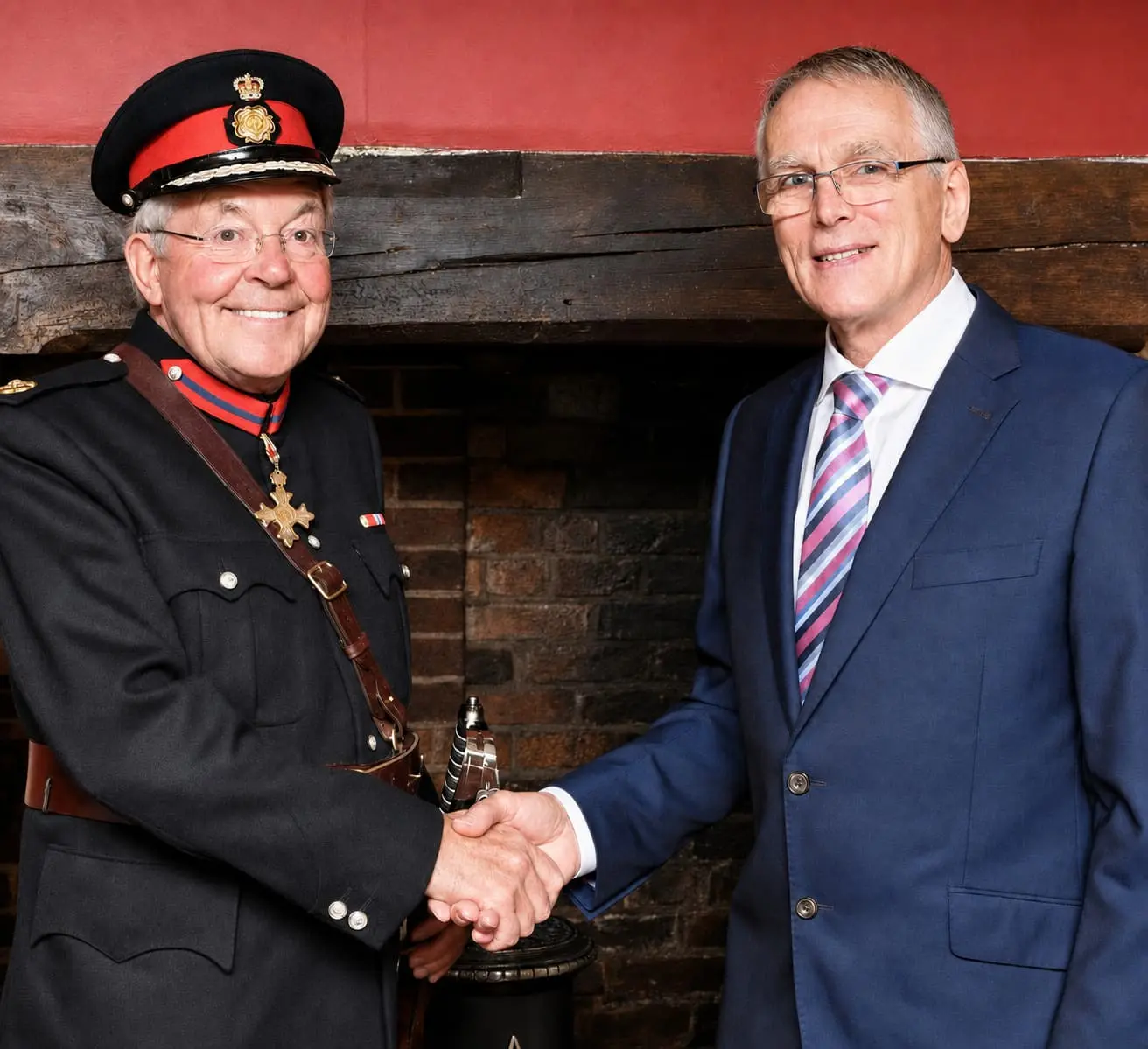
Awarded for the microK, developed in collaboration with Isotech. The award was announced on the Queen’s birthday and presented on her behalf by the Vice Lord-Lieutenant of Northamptonshire, Sir Peter Ellwood CBE, who came to Metrosol to do it on 5 September.
The microK was the first product we designed, supported by a research and development grant from the East Midlands Development Agency in 2004. It is used in national measurement institutes and calibration laboratories worldwide to establish and hold a temperature scale.
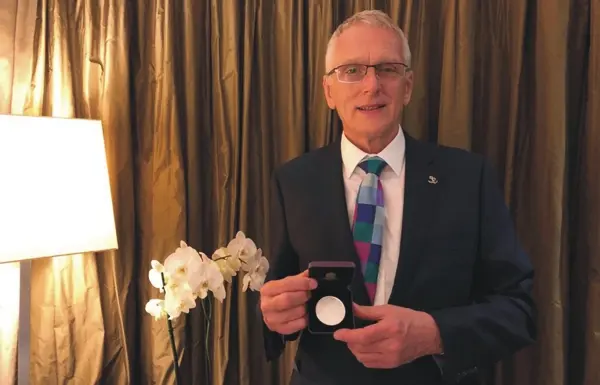
The Callendar Medal, awarded to Paul Bramley
On 23 October 2019 Paul went down to the Royal Institution in London to be presented with the Callendar Medal by the Institute of Measurement and Control. The medal recognises the work of the late Professor H. L. Callendar and goes annually to an engineer or scientist who has made an outstanding contribution to the art of instruments or of measurement. Paul’s was for the development of a practical Johnson noise thermometer.
It is an individual award, and Paul was quick to say so at the time:
This is a tremendous honour, for which I can only thank the institute. Although it is an individual award, I must acknowledge that this is a collective effort with invaluable contributions from my colleagues Dr David Cruickshank and Jeremy Gill, John Pickering of Metron Designs as well as the support and assistance from NPL, in particular from Dr Jon Pearce and Dr Jonathan Williams. I enjoy running in my spare time and this project feels a little like running a marathon. What feels strange is that I seem to be receiving a medal at about the 22 mile mark, just as I’m hitting the wall. When I pointed this out, I was assured that the selection committee had every confidence the project would be successful, so no pressure then.
ThermoSI, and the work to 1,200 °C
Metrosol is part of ThermoSI, the European project on thermometry with embedded SI traceability for industrial applications. Work package 2 exists to take practical Johnson noise thermometry to 1,200 °C, at a target uncertainty below 3 °C, and to develop sensor elements that survive at that temperature and under ionising radiation.
Three other approaches are being pursued in the same work package, from the University of Ljubljana, the Czech Metrology Institute and PTB.
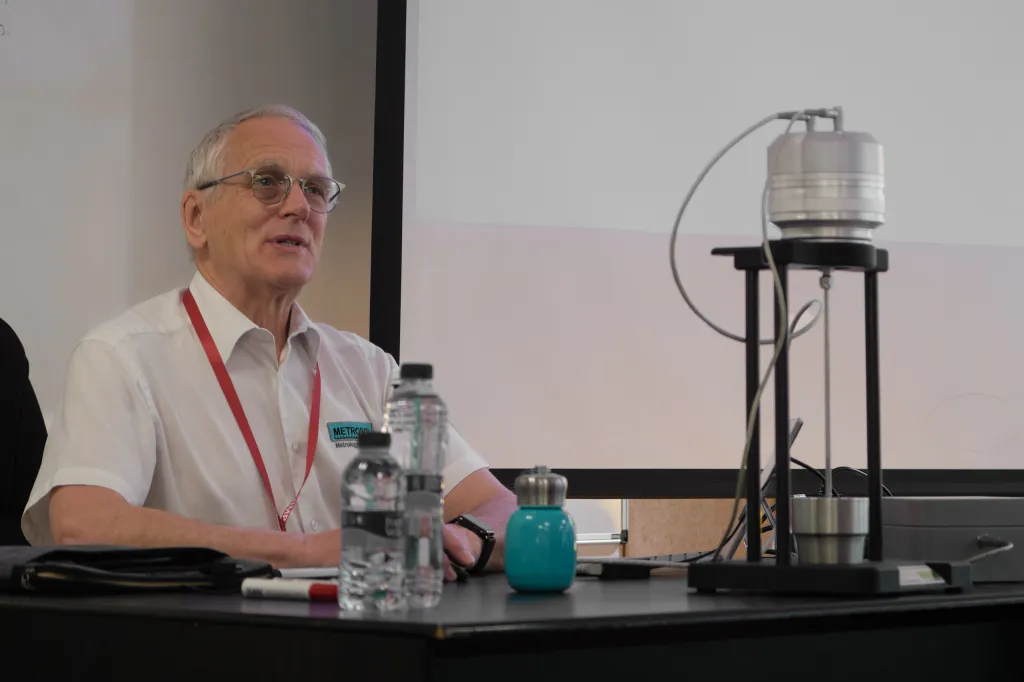
In May 2026 Paul presented practical Johnson noise thermometry at the European summer school on primary thermometry in Santander, held under the DireK-T project on dissemination of the redefined kelvin. He took the prototype and ran it live.
On the shelf at Paulerspury
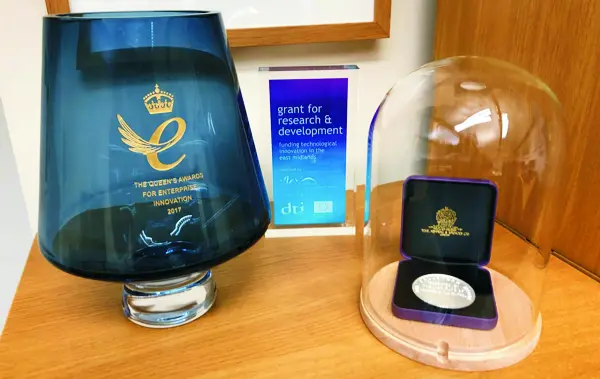
The Queen’s Award trophy, the Callendar Medal under glass, and behind them the East Midlands Development Agency grant that paid for the research and development work on the microK in 2004. Twenty-two years apart, and the same programme runs through all three.
The Callendar Medal citation is in the InstMC awards programme for 2019. The high-temperature work is described by the consortium under ThermoSI work package 2.