Instrument design and measurement science.
An instrument design and measurement science company that began trading in 2004, based in Paulerspury, Northamptonshire. An Isotech company since April 2026, with its own staff and its own programme of research and development.
A partnership built on technical instinct
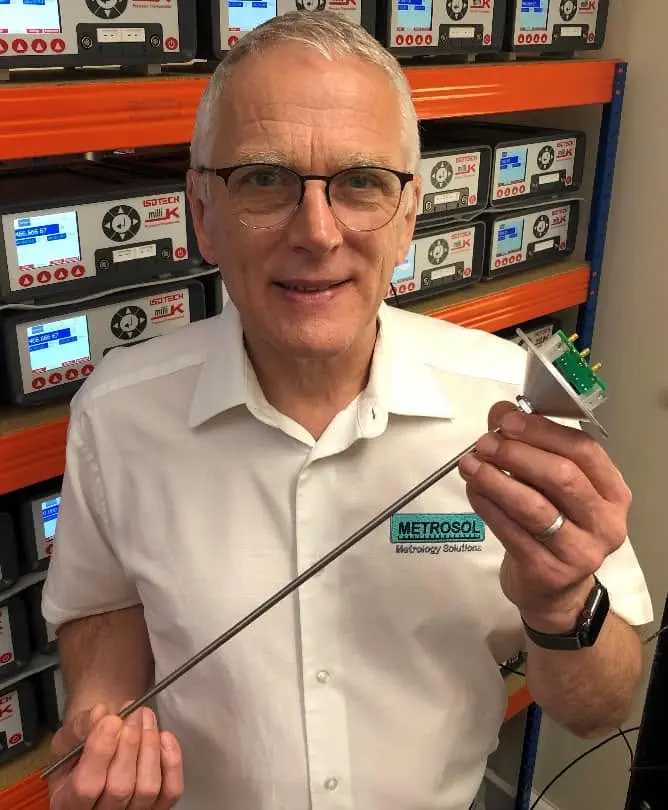
Paul Bramley set up Metrosol in 2004, shortly after leaving Automatic Systems Laboratories, where he had been Technical Director. He thought bridge instrumentation needed a different architecture: the established designs relied on hand-wound transformers and ageing analogue techniques, and he wanted to replace that with digital measurement and a bridge whose key errors cancelled by design.
Isotech had already built a wide range for temperature calibration, SPRTs, fixed-point cells, calibration baths and dry blocks, but no thermometry bridge. John Tavener, then President of Isotech, recognised the fit: Metrosol had the design capability, Isotech had the calibration expertise, the manufacturing and the route to market. There was no long-term plan, just a judgement that the two businesses fitted.
It started with a handshake.
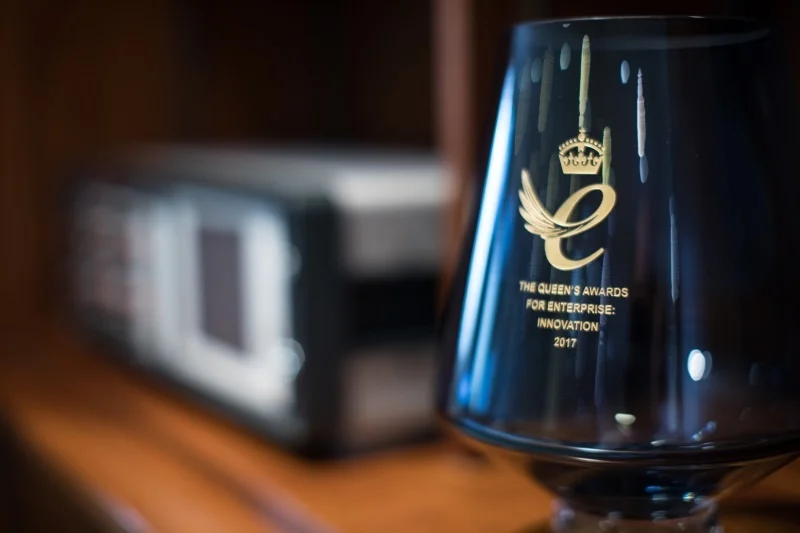
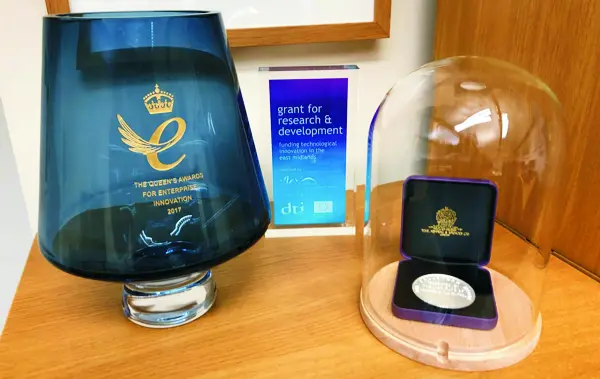
That judgement held. Together we developed the microK, then the milliK and the microK², a new generation of thermometry bridges on digital techniques rather than analogue ones. The work was recognised with a Queen’s Award for Enterprise in Innovation, and our instruments are used today by national measurement institutes and calibration laboratories worldwide.
A second strand of research
Alongside the bridge programme, we were pursuing a different measurement problem: reading temperature directly from the electrical noise in a resistor, rather than from a sensor’s calibration. The principle was well established, but turning it into a practical instrument was not, and for years this stayed a research programme alongside the bridge business, producing patented methods and published research. The problem left was not proving the principle. It was building a route from research instrument to practical use.
Uncompromising
Uncompromising is a strong word, but precision measurement demands that level of attention. The difference between a good instrument and one trusted by a national measurement institute often lies in details that are invisible from the outside. Our design record is where that claim is tested.
In 2004 the best analogue-to-digital converter on the market managed 3 ppm linearity, and we would not build around it. Correcting its behaviour in software was available and we would not do that either, because a correction is a model of the part you happen to have measured and it stops being true as that part ages. So the converter was designed from scratch, with NPL and Metron Designs, and reached better than 0.5 ppm.
Mechanical relays were the conventional way to switch signals and are the component most likely to fail, so the instruments have none, and getting rid of them meant solving a leakage problem that took a switching arrangement of our own. Then, having built an instrument good to 0.1 ppm, we had no way to prove it, because that needs a laboratory an order of magnitude better again. So we built the laboratory.
- Our own laboratory verification capability
- <0.01 ppm
- The multi-bit sigma-delta converter behind the microK was developed with NPL and Metron Designs
What the work involves
We model precision analogue and digital circuits analytically and numerically, carry out our own mechanical and PCB design, and prototype early to get ideas onto the bench quickly. Our software is written in C, C++ and C#. Together, those disciplines allow us to take an instrument from a measurement requirement through to a fully engineered design.
What changed in April 2026
On 2 April 2026 Isothermal Technology acquired Metrosol, after twenty years of working together on precision instrumentation. We continue to operate with our own staff, in the same building, on the same programme, and the Johnson noise thermometry work now has the same route to market that took the microK from a research instrument to an established one.
We continue to focus on research, measurement science and instrument design. Isotech provides the engineering, manufacturing, calibration and worldwide support needed to take that research into practical use. The bridge programme asked whether an established measurement could be done differently. The Johnson noise programme asks the same question at a more fundamental level.