Twenty years of instruments.
We first started working with Isotech in 2004 on the development of the microK precision thermometry bridge. We have continued to collaborate on precision instrumentation since then, most recently on the second-generation microK². These case studies describe the research, design and development behind each instrument, the engineering decisions involved and the investment required to take them into production. Isotech brings them to market, supplying, calibrating and supporting them worldwide.
One thread runs through all of it.
Every one of these instruments began with a measurement problem that had no answer on the market. The first microK needed an A-D converter nobody made, so we developed one with NPL and Metron Designs and reached a linearity better than 0.5 ppm. Taking the platform to 0.1 ppm in 2009 needed a parallel analogue processing technique that did not exist either. The Johnson noise thermometer is the furthest that has gone, a thermometer that does not depend on its sensor’s calibration holding, and both the measurement technique and the instrument concept are patented.
- Thermometry bridge · From 2024microK²A ground-up redesign of the instrument that started all of this, and the one that finally retired the original microK.
- Thermometry bridge · 2004 to 2024microK 250 and microK 500The first instrument we designed, and the one that made us build our own converter. For secondary standards work.
- Thermometry bridge · 2009 to 2024microK 70 and microK 125Taking the same platform into primary standards work, which meant an order of magnitude and a great deal of trouble.
- Precision thermometer · From 2010milliKA precision thermometer against a manufacturing budget that would not stretch. The interesting constraint was cost.
- Channel expansion · From 2007microsKannerNinety extra channels for the microK, with no loss of performance and no relays.
- Channel expansion · From 2011millisKannerA lower-cost scanner for the milliK, with signal reversal built in to remove thermal EMF errors.
- Bridge calibration · From 2013Resistance bridge calibratorNot our technology. Our production engineering, and a laboratory capability we had to build to do it.
Where they end up
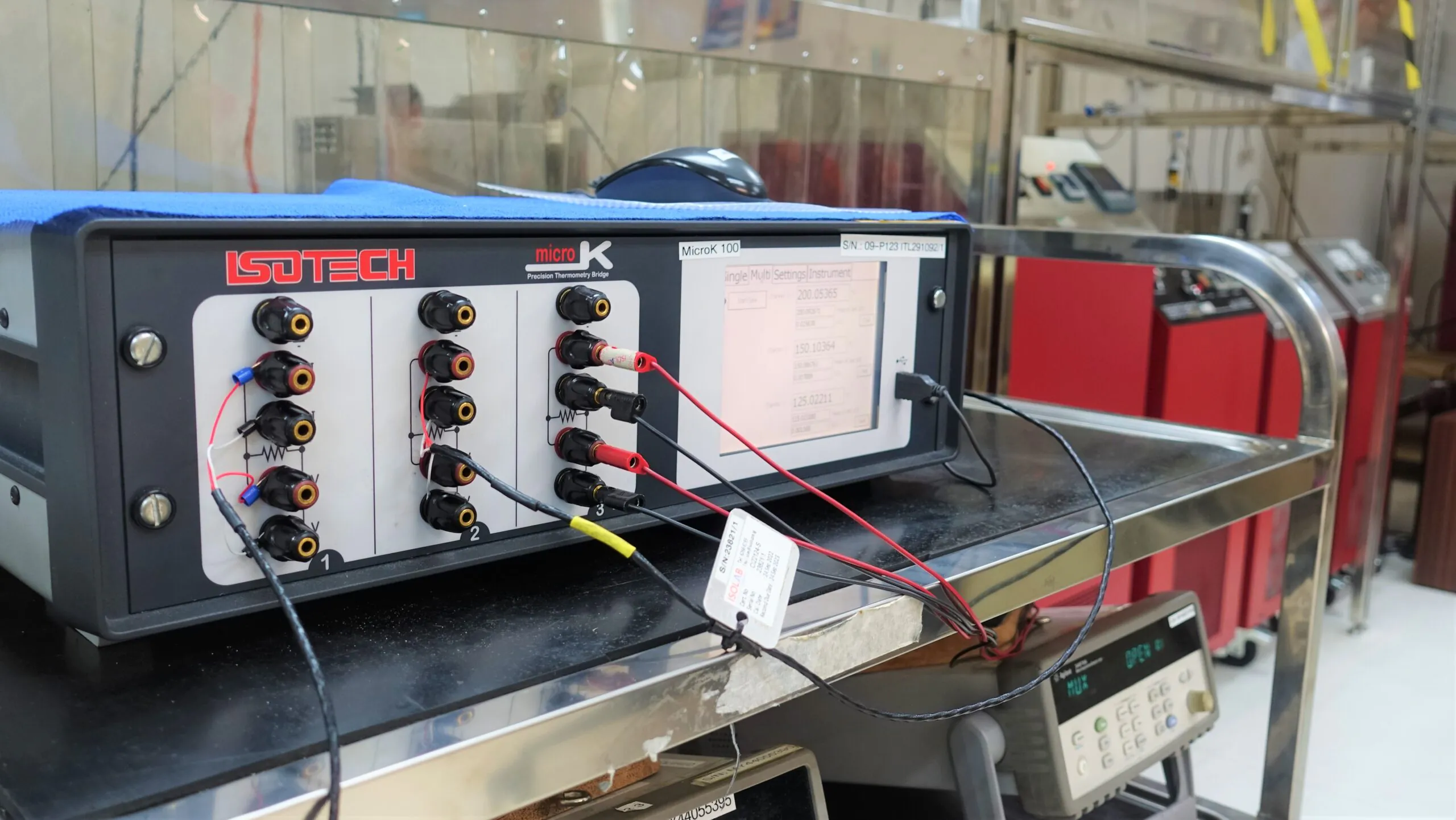
National measurement institutes and calibration laboratories, mostly, realising and disseminating ITS-90. The instrument below is a microK doing exactly that.