The probe no longer needs a fixed calibration relationship.
A conventional temperature probe depends on known characteristics, established through its materials, manufacture and, where required, calibration. Remove the need for a fixed calibration relationship and many of those constraints disappear.
A platinum resistance thermometer is designed so that its resistance follows a predictable relationship with temperature. The choice of platinum, construction, heat treatment and calibration are all intended to establish and preserve that relationship. The instrument then converts resistance to temperature on the assumption that the relationship has not changed.
A noise thermometer makes no such assumption. It measures the resistance it finds and uses that. All we ask of a probe is that it be resistive, that its resistance sit in a workable range, and that it survive the environment. Nothing else about it has to be known in advance.
The sensor does not have to be a good thermometer. It has to be a resistor that is in thermal contact with the thing you want to measure.
What this opens up
A sensor that has already degraded still works. If a probe has oxidised, picked up contamination, or been sitting in a neutron flux long enough that some of its atoms are now a different element, its resistance will have moved a long way from where it started. For a conventional thermometer that is a failed sensor. Here it is simply a resistor with a different value, measured afresh every few seconds.
It also means a probe can be built for the environment instead of for the calibration laboratory. Where survivability, geometry or cost matters more than metrological pedigree, the design space is wider than it is for any sensor that has to hold a certified characteristic for years.
What still constrains it
Resistance value is the practical one. We work at around 5 kΩ, considerably higher than the 100 Ω or so used in earlier noise thermometry, because a larger resistance generates more Johnson noise and gives us more signal to work with. Probes far outside that range cost us measurement time.
Cable capacitance is the other. Sensor resistance and cable capacitance together form a low-pass filter, and because the useful bandwidth runs to 1.2 MHz, that filter starts eating into the top of the measurement band. Short cables with low capacitance are strongly preferred, and this is a real constraint on installation, not a detail.
None of that is a calibration requirement. It is an engineering trade between resistance, cable and measurement time, and we settle it at install instead of certifying it in advance.
Probes as fitted
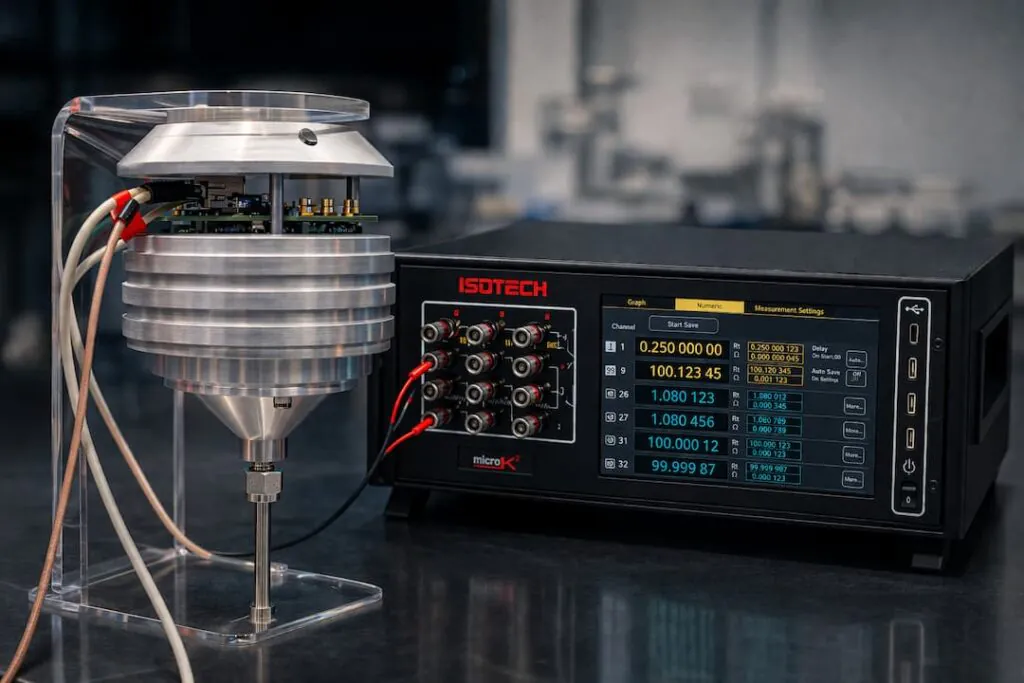
The current unit takes a sheathed probe through a compression fitting at the front of the enclosure, which is the arrangement shown here beside a microK. Probe design for specific environments is one of the things we are working on with application partners.
The sense resistance and bandwidth figures are from Developments Towards an Industrial Johnson Noise Thermometer (2019), §7.Why resistance changes do not change the temperature reading.